
Editorial Process
Asia Journal of Social Innovation and Development (AJSID) maintains a rigorous, transparent, and efficient evaluation system for all submitted manuscripts. Our editorial workflow safeguards scholarly excellence while providing authors with constructive guidance at each stage of the publication journey.
Peer Review Model: Double-Blind
Every manuscript submitted to AJSID passes through a structured, multi-step evaluation pathway. The process is jointly managed by our Editorial Office,independent Academic Editors and reviewers, ensuring that each submission receives thorough, fair, and timely assessment. No fewer than two specialist evaluation reports are gathered for every manuscript prior to any editorial determination.
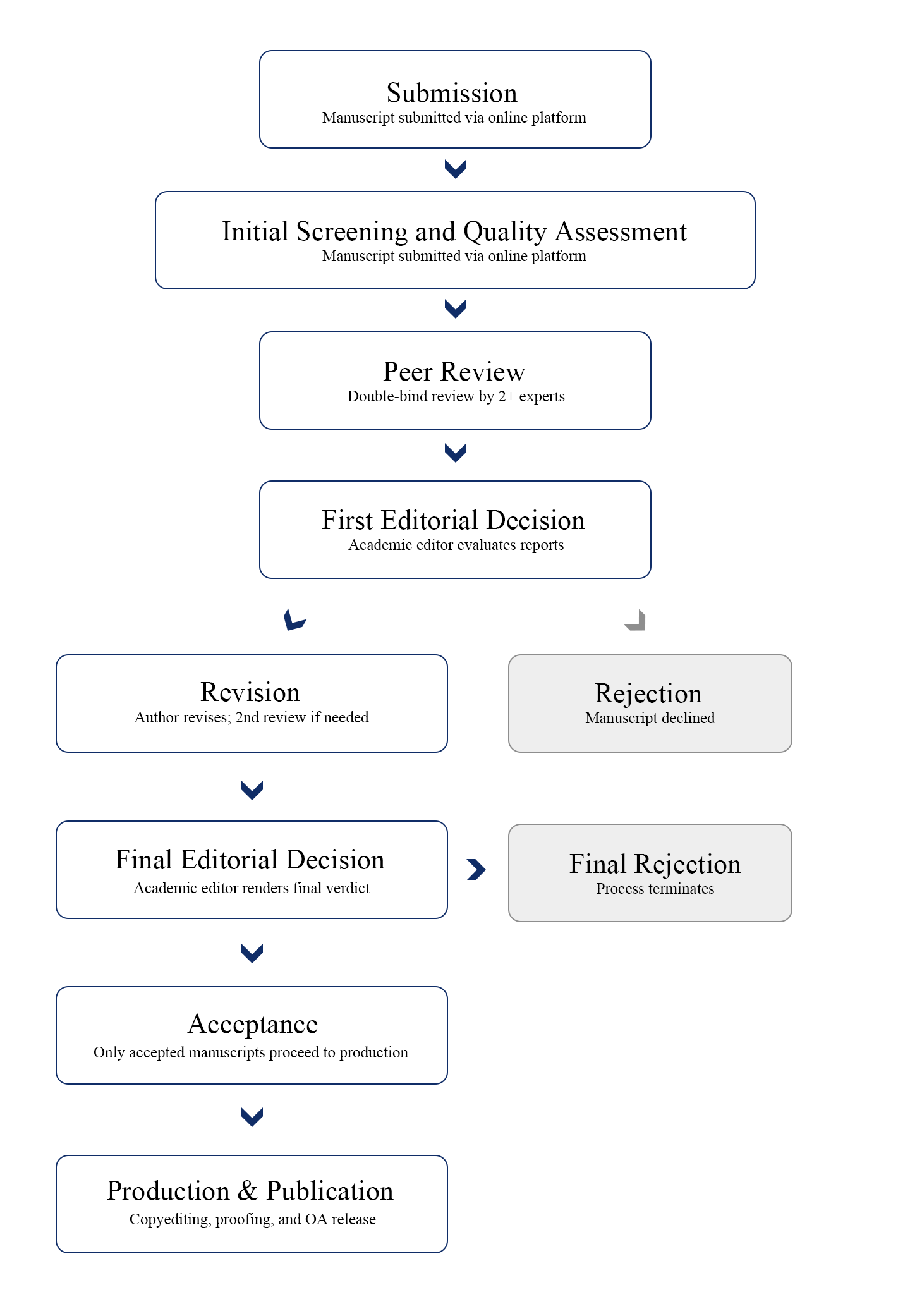
1.Initial Screening and Quality Assessment
The screening stage comprises two consecutive evaluations: a technical screening executed by the Editorial Office, followed by an academic assessment conducted by a designated Academic Editor. This dual-layer approach filters out submissions that do not satisfy our foundational scope, quality, or ethical criteria before they enter peer review.
1.1 Technical Screening
Upon receipt of a submission, the Managing Editor carries out a comprehensive technical review covering the following dimensions:
- Topic Relevance: Whether the manuscript's subject matter aligns with the journal's focus on social innovation and development.
- Formatting Adherence: Whether the manuscript conforms to the Topic Selection Guide & Author Submission Manual regarding citation format, file specifications,etc.
- Originality Verification: Similarity detection using professional plagiarism-screening tools to uncover any undue textual overlap with existing literature.
- Ethical Compliance: Confirmation that appropriate research ethics approvals, participant consent documentation, and adherence to publication integrity norms are in place.
- Language Proficiency: Evaluation of whether the English writing quality meets the threshold necessary for substantive expert review.
Submissions found to have material deficiencies at this juncture may be sent back to authors for correction prior to entering peer review, or may be declined outright if the problems are irreparable. Any flagged concerns are communicated to the Academic Editor for their awareness.
1.2 Academic Editor Assessment
Once a manuscript clears the technical screening, it is allocated to an Academic Editor who conducts a discipline-specific evaluation. This assessment encompasses:
- The degree to which the submission aligns with the journal's stated scope and objectives
- The overall academic rigor and soundness of the research methodology
- The originality and scholarly significance of the contribution
- The suitability and currency of the referenced literature
- The appropriateness of reviewer candidates put forward by the authors and the Editorial Office
Following the academic assessment, the Academic Editor may: (1) decline the manuscript without subjecting it to peer review, (2) ask for modifications prior to initiating the review process, or (3) endorse the manuscript for peer review,and recommend potential qualified reviewers.
Conflict of Interest:
Academic Editors are obligated to reveal any actual, potential, or perceived conflicts of interest that could compromise their objectivity. Editors may not participate in the evaluation of any manuscript where they serve as an author or where an institutional or collaborative relationship exists.
2.Peer Review
AJSID employs a double-blind review framework in which the identities of both author and reviewer are concealed from one another. This approach is intended to reduce conscious and unconscious bias, ensuring that each manuscript is judged purely on its intellectual content.
2.1 Identification of Qualified Reviewers
The Editorial Office dispatches review invitations to scholars in the field of the manuscripts. No fewer than two independent evaluation reports are required per manuscript. Reviewer candidates are drawn from several channels:
- Author-Suggested Reviewers: Authors may propose prospective reviewers at the point of submission. Every recommendation undergoes screening for conflicts of interest and academic appropriateness before an invitation is issued.
- Editorial Board/Reviewer Board Contributors: Board members/Reviewer Board members possessing pertinent subject-matter expertise may be invited to serve as reviewers, contingent upon conflict-of-interest clearance.
-Curated Expert Network: The editorial team maintains a continuously updated reviewer database and proactively identifies supplementary qualified experts through systematic literature searches and citation tracing.
2.2 Qualification Requirements for Reviewers
Every invited reviewer must satisfy the following conditions to safeguard the quality and integrity of the evaluation process:
- Absence of Conflicts of Interest: Reviewers must be free of any financial, institutional, or collaborative entanglements with any author of the manuscript.
- Institutional Separation: Reviewers must not hold an appointment at the same organization as any author.
- Co-Authorship Restriction: Reviewers must not have co-authored work with any author within the preceding five years.
- Credentials: Reviewers must possess a doctoral-level degree (PhD or equivalent) and demonstrate a verifiable publication track record in the relevantfield, which can be confirmedthrough Scopus, Web of Science, Google Scholar or ORCID.
- Disciplinary Specialization: Reviewers must be active researchers with recognized proficiency directly relatedto the manuscript's topic.
2.3 Review Timeline
- Initial Assessment Window: Upon accepting an invitation, reviewers ordinarily receive 7–10 calendar days to prepare and submit their evaluation report via the online platform. Extension requests are routinely accommodated.
- Revised Manuscript Evaluation: For evaluating revised manuscripts, a 3-day turnaround is requested. Extension requests may also be accepted if time permits.
- Reviewer Obligations: Reviewers are expected to deliver constructive, comprehensive, and punctual assessments; preserve confidentiality of all submitted materials; declare any potential conflicts; and uphold professional and ethical norms throughout their involvement.
2.4 Reviewer Outcome Options
Reviewers may issue one of the following recommendations:
- Accept: The manuscript warrants publication as submitted, with no further changes needed.
- Minor Revision: The manuscript is methodologically sound but requires limited adjustments. These modifications are reviewed by the Academic Editor; a 2nd review is generally unnecessary.
- Major Revision: The manuscript needs significant reworking before it can be considered viable for publication. A subsequent round of expert evaluation will follow receipt of the revised version.
- Reject: The manuscript is unsuitable for publication in its present state due to fundamental inadequacies. The same manuscript may not be resubmitted. However, we encourage re-submission after further modification.
3. First Decision
After no fewer than two evaluation reports have been received, the designated Academic Editor examines the reviewers' recommendations, evaluates the substance and quality of their feedback, and weighs the overall academic merit of the manuscript.
The Academic Editor may issue one of the following preliminary determinations:
- Accept as Submitted: The manuscript is approved without requiring any modifications and can be advanced directly to the production stage.
- Minor Revision: The manuscript needs minor corrections. Authors ordinarily receive 5 days to submit the revised version, which will then be examined by the Academic Editor.
- Major Revision: The manuscript requires substantial reworking. Authors ordinarily receive 10 days to respond. The revised manuscript is returned to the original reviewers for a second round of evaluation.
- Decline with Resubmission Encouraged: The manuscript needs extensive revision but may ultimately prove suitable. Following completion of the necessary modifications, authors may submit the work as a new manuscript. The new submission is assigned a fresh manuscript ID and linked to the prior record.
- Decline without Resubmission: The manuscript is rejected on fundamental grounds. The same work may not be submitted again.
- Invite Additional Reviewer(s): When existing evaluations are conflicting or insufficient, the Academic Editor may recruit one or more supplementary reviewers to add additional expert perspectives.
4.Revision and 2nd-Review
When a revision is requested, the Editorial Office transfers the decision along with all reviewer feedback to the authors. Authors are required to submit a detailed, point-by-point reply addressing every reviewer remark, accompanied by the revised manuscript.
4.1 Revision Timeframes
- Minor Revision: Authors ordinarily receive 5 days to finalize minor modifications. Extensions can be arranged upon request.
- Major Revision: Authors ordinarily receive 10 days to finalize major modifications. Extensions can be arranged upon request.
- Maximum Revision Rounds: A maximum of two major revision cycles is typically permitted. Further rounds may be authorized at the Academic Editor's discretion.
4.2 2nd Review Procedures
Whether revised manuscripts are sent back to the original reviewers depends on the decisions Academic Editors made and the requirements and willingness expressed by each reviewer:
- Minor revisions are normally inspected by the Academic Editor without being routed back to reviewers.
- Major revisions are invariably returned to the original reviewers for a 2nd review.
- Reviewers whose recommendation was rejection are always invited to evaluate the revised version.
- All reviewers retain the ability to view the latest version of the manuscript through the submission system.
Withdrawal Due to Prolonged Inactivity:
If the Editorial Office loses contact with the corresponding author during the evaluation or production process, the journal may administratively withdraw the manuscript after a specified period of inactivity and after reasonable efforts to re-establish communication have been exhausted.
5.Final Decision
The decision to accept or reject a manuscript rests entirely with the designated Academic Editors, who bears full responsibility for the final outcome. Reviewers' recommendations serve only as a suggestion; the Academic Editors may choose whether or not to follow them but must have sufficient reasons for their decision.
5.1 Verification Before Making Decision
Prior to making a final decision, the Academic Editor verifies:
- The thoroughness and adequacy of the reviewer feedback
- The completeness and quality of the author's revision response
- The overall academic caliber and intellectual contribution of the manuscript
- Conformance with all ethical and formatting stipulations
5.2 Acceptance
Upon verifying that the manuscript satisfies all scholarly, ethical, and formatting stipulations, the Academic Editor formally accepts the manuscript. Only accepted manuscripts are advanced to the production and publication phase. The Editorial Office informs the corresponding author of the acceptance and sets the production workflow in motion.
5.3 Final Rejection
When the Academic Editor concludes that the manuscript falls short of the requisite scholarly benchmarks — whether owing to fundamental methodological deficiencies, insufficient originality, scope mismatch, or unresolved reviewer concerns — a final rejection is issued. The rejection communication provides a summary of the grounds for the decision along with reviewer feedback.
A final rejection ends the editorial process for that manuscript. Rejected manuscripts are not carried forward into any subsequent production or publication stage. Based on the decisions, authors may:
- Decline with Resubmission Encouraged: The manuscript shows promise but needs extensive reworking. After completing the required modifications, authors may submit the work as a new manuscript. The new submission will receive a fresh manuscript ID and go through a complete new evaluation cycle.
- Decline without Resubmission: The manuscript is rejected on fundamental grounds. The same work may not be submitted again.
5.4 Double Decision Making Protocol
In situations where the Academic Editor favors acceptance despite one or more reviewers advising rejection, a double decision making protocol is triggered. The Editorial Office obtains an additional independent assessment from an Editorial Board member or the Editor-in-Chief. The conclusion reached through this second assessment is conclusive.
Note: The authority to accept manuscripts for publication is reserved exclusively for Academic Editors. Editorial Office do not make acceptance or rejection decisions.
6. Author Appeals
Authors who consider a rejection outcome stem from a substantial misinterpretation or factual oversight may file an appeal. All appeals receive serious, impartial consideration.
Conditions and Procedure:
- Appeals are restricted to manuscripts that received a "decline without resubmission" outcome.
- The appeal must be lodged within 3 months of the rejection date.
- The appeal must contain a thorough justification with point-by-point replies to the reviewers' and/or Academic Editor's observations.
- Appeals are to be directed to the journal's Editorial Office via email.
Upon receiving a qualifying appeal, the Managing Editor will transfer the manuscript and all associated documents (reviewer identities included) to an Editorial Board member who had no involvement in the original decision making. This independent editor supplies an advisory opinion, which is subsequently checked by the Editor-in-Chief. The Editor-in-Chief's ruling on appeal is conclusive and not subject to further appeal.
7. Production & Publication
Upon acceptance, the manuscript enters the production phase, during which it undergoes professional processing to guarantee optimal presentation quality prior to online dissemination. All AJSID articles are released as fully open-access content under a Creative Commons license CC-BY 4.0.
Authors should review proofs promptly and submit any corrections within the specified timeframe. Generally, substantive changes to the main text are not permitted after a manuscript has been accepted. If an author deems such changes necessary, they must submit a detailed justification to the Editorial Office; in such cases, the manuscript may be returned to the Academic Editor for re-evaluation.
8. Editorial Independence
AJSID maintains a strict firewall between editorial decisions and commercial or financial considerations. All decisions to accept or reject manuscripts are made by academic editors solely on academic merit, without influence from commercial operations or revenue-generating considerations.
This commitment to editorial independence ensures that every published paper meets the same rigorous quality standards, regardless of the author's affiliation, geographic location, or financial circumstances. The journal offers fee waivers for excellent papers from low- and middle-income countries, and the approval process for these waivers is entirely separate from the editorial review process.